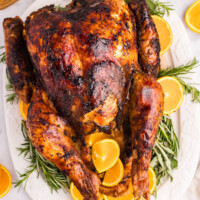
Orange Glazed Turkey
This orange glazed turkey recipe makes the perfect Thanksgiving turkey—juicy, flavorful, and golden, with a sweet citrus glaze your guests will love.
Servings: 16
Calories: 869kcal
Ingredients
For the Turkey
- 20 lb. whole turkey thawed
- 1 cup unsalted butter (2 sticks), softened
- 2 teaspoons garlic powder
- 2 teaspoons onion powder
- 1 tablespoon salt
- 2 teaspoons black pepper
- 2 teaspoons smoked paprika
- 1 tablespoon rubbed sage
- 2 tablespoons fresh rosemary finely chopped
- 1 onion quartered
- 1 orange halved
- 4 sprigs fresh rosemary
- 2 cups low-sodium chicken broth or turkey broth for roasting pan
For the glaze
- 1 cup orange marmalade
- 1/3 cup orange juice freshly squeezed or orange juice concentrate
- 1 tablespoon Dijon mustard
- 2 cloves garlic finely chopped
- 1 tablespoon soy sauce
- 1 teaspoon fresh rosemary finely chopped
For the gravy
- Drippings from the pan
- 1/4 cup all-purpose flour
- 1 1/2 cups chicken or turkey broth
Instructions
- Preheat oven to 325°F. Remove giblets and neck from the turkey cavity; pat the bird dry with paper towels.
- In a small bowl, mix the softened butter with garlic powder, onion powder, salt, pepper, paprika, rubbed sage, and chopped rosemary.
- Gently loosen the skin over the breast side and rub some of the seasoned butter under the skin. Slather the remaining butter mixture all over the outside of the turkey.
- Add the onion quarters, orange halves, and rosemary sprigs to the cavity of the turkey.
- Tie the legs together with kitchen twine and tuck the wing tips under to prevent the tips from overcooking.
- Transfer the turkey onto a rack in a large roasting pan, then pour the broth into the bottom of the pan.
- Roast the turkey for about 14 minutes per pound, or for about 3 hours for a 12-pound turkey or 4.5 hours for a 20-pound turkey, until an instant-read thermometer inserted in the thickest part of the thigh reads 165°F.
- While the turkey roasts, combine the marmalade, orange juice, Dijon mustard, garlic, soy sauce, and rosemary in a small saucepan.
- Simmer over medium-low heat for 5–7 minutes, until slightly thickened. Set aside.
- Make the Glaze: During the last hour of roasting (about when the turkey hits an internal temperature of 130 degrees F), begin brushing the turkey with the orange glaze every 10–15 minutes.
- Keep a close eye during this stage to prevent burning due to the sugars in the glaze.
- Once the turkey reaches 165°F, remove it from the oven and tent with foil. Allow the roasted turkey to sit and rest for at least 30 minutes before carving to allow pan juices to redistribute.
- Make the Gravy: Once the turkey is out of the oven and resting, pour the drippings into a bowl or a fat separator (if you have one). Let the fat rise to the top and skim off most of it, leaving about 2 tablespoons of fat with the drippings.
- To a saucepan, add the broth, flour, and the drippings. Set over medium heat and stir to combine so the flour is fully incorporated. Bring to a boil and allow to thicken. Test the taste and season with salt and pepper as necessary. Once thickened, remove from the heat and transfer to a gravy boat.
Notes
Tips:
- If working with a very cold turkey, it can be hard to get the butter to spread evenly on the outside of the turkey. I recommend removing the turkey from the refrigerator to allow it to warm for about 90 minutes before working on the bird.
- Pat the turkey dry before applying the butter rub to help the skin crisp up in the oven and allow for easier distribution of the butter.
- Start glazing only during the last hour of roasting to avoid burning the sugars in the marmalade.
- Use a meat thermometer to ensure perfect doneness. You want an internal temperature of 165°F (74°C) in the thickest part of the thigh.
- Rest the turkey for at least 30 minutes after roasting to allow juices to redistribute. Resting the turkey keeps the meat moist and flavorful.
- If you want an extra-deep flavor, brine the turkey (wet or dry brine) one day before roasting.
- Apricot preserves or peach jam work as good substitutes, but orange marmalade gives the best balance of sweetness and citrusy bitterness for this glaze.
- Store the cooled leftover turkey in an airtight container or tightly wrap the turkey in some plastic wrap and foil in the refrigerator for 4 days.
- For the gravy, store the cooled gravy in a sealed container in the refrigerator for up to 4 days. Reheat the gravy in a saucepan over the stovetop on low heat, whisking while it’s warmi
Nutrition
Serving: 1serving | Calories: 869kcal | Carbohydrates: 16g | Protein: 111g | Fat: 39g | Saturated Fat: 14g | Polyunsaturated Fat: 8g | Monounsaturated Fat: 12g | Trans Fat: 1g | Cholesterol: 390mg | Sodium: 1043mg | Potassium: 1221mg | Fiber: 1g | Sugar: 12g | Vitamin A: 745IU | Vitamin C: 5mg | Calcium: 77mg | Iron: 5mg
